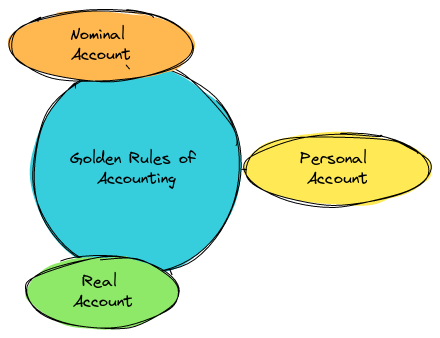
Understanding Real, Personal, and Nominal Accounts in Accounting
In accounting, accounts are classified into three main types: real, personal, and nominal. Each type has distinct characteristics and serves different purposes in the recording and reporting of financial transactions. This essay will delve into each type, providing examples to elucidate their functions and importance in accounting.
Real Accounts
Real accounts pertain exclusively to assets. These accounts are permanent in nature and do not close at the end of the accounting period. Instead, their balances are carried forward to the next accounting period. Real accounts can be further divided into tangible and intangible accounts:
Tangible Real Accounts:
These include physical assets that can be seen and touched. Examples are:
Land: The account used to record the cost of purchasing land.
Buildings: The account used to record the cost of buildings owned by the business.
Machinery: The account used to record the cost of machinery used in production.
Equipment: The account used to record the cost of various equipment used in business operations.
Cash/Bank The account used to record the amount of cash available to a business at any particular time.
Intangible Real Accounts :
These include non-physical assets that hold value. Examples are:
Patents: The account used to record the cost of patents acquired by the business.
Trademarks: The account used to record the cost of trademarks.
Goodwill: The account used to record the value of goodwill acquired.
Debit what comes in, Credit what goes out
The fundamental principle governing real accounts is: “Debit what comes in, credit what goes out.” This ensures that the value of assets is accurately reflected in the financial statements.
Personal Accounts
Personal accounts relate to individuals, firms, companies, and other entities with which the business interacts. These accounts can be categorized into three types:
Natural Persons:
Accounts related to individual human beings.
John Doe’s Account: If John Doe provides consulting services to the business worth $1,000, the business will record this transaction in John Doe's Account as a liability until the payment is made.
Artificial Persons:
Accounts for entities like companies, organizations, institutions and government entities.
XYZ Ltd.’s Account: Tracks transactions with XYZ Ltd., such as purchases or services rendered.
Representative Personal Accounts:
Accounts that represent a group of individuals or accounts.
Accounts Payable: Represents money owed by the business to its suppliers.
Accounts Receivable: Represents money owed to the business by its customers.
Personal accounts measure obligations to and from an entity with which the business interacts
Personal accounts follow the golden rule: “Debit the receiver, credit the giver.” This rule helps in tracking the amounts owed to or by individuals and entities, ensuring that transactions are properly recorded to reflect the business’s financial obligations and claims.
Nominal Accounts
Nominal accounts are used to record all income, expenses, gains, and losses. These accounts are temporary and are closed at the end of each accounting period by transferring their balances to the profit and loss account. The primary purpose of nominal accounts is to measure the business’s performance over a specific period. Examples include:
Expenses and Losses:
Accounts related to costs incurred by the business.Accounts related to costs incurred by the business.
Rent Expense: Records the cost of rent paid for office or retail space.
Salary Expense: Records the cost of salaries paid to employees.
Utility Expense: Records the cost of utilities such as electricity, water, and gas.
Loss on Sale of Assets: Records the loss incurred from selling an asset below its book value.
Incomes and Gains:
Accounts related to revenues earned by the business.
Sales Revenue: Records income from the sale of goods or services.
Interest Income: Records income earned from interest on investments.
Commission Received: Records income from commissions earned.
Gain on Sale of Assets: Records the gain earned from selling an asset above its book value.
The rule for nominal accounts is: “Debit all expenses and losses, credit all incomes and gains.” This rule ensures that all financial activities impacting the profitability of the business are accurately recorded. Understanding the distinctions between real, personal, and nominal accounts is crucial for maintaining accurate financial records. Real accounts track assets, personal accounts manage transactions with individuals and entities, and nominal accounts measure financial performance. By adhering to the specific rules governing each type of account, businesses can ensure their financial statements provide a true and fair view of their financial position and performance. This structured approach to accounting helps in effective financial management, decision-making, and compliance with legal and regulatory requirements.
The difficulty with nominal accounts
Nominal accounts can be tricky because they deal with the intangible but measurable dissipation of resources and the delivery of benefits to customers and clients. Let’s make this clearer by connecting these abstract concepts to real-world physical events. These events directly lead to debit or credit entries in nominal accounts, and it’s crucial to understand that these entries represent the monetary measurement of activities, independent of the corresponding payment or receipt.
Dissipation of Resources
1. Physical Events Leading to Debits:
Employees Physically Working:
Event: Employees carry out their tasks, such as manufacturing products, providing services, or handling administrative work.
Accounting Impact: The work done by employees is measured in terms of salaries expense, reflecting the cost of their labour.
Example: If employees have worked and earned €10,000 in salaries:
Debit: Salaries Expense €10,000 (indicating the monetary measurement of the labour consumed)
The credit entry depends on whether the salaries have been paid:
If paid immediately: Credit Cash/Bank €10,000
If not yet paid: Credit Salaries Payable €10,000 (indicating the obligation to pay)
The Salaries expense is not money but a measurement of Labour consumed over a period of time in terms of money
Units of Electricity Being Consumed:
Event: The business uses electricity for operations, such as lighting and running machinery.
Accounting Impact: The electricity consumed is recorded as an expense, regardless of whether the bill has been received or paid.
Example: If the company has used €500 worth of electricity:
Debit: Electricity Expense €500 (reflecting the cost of electricity consumed)
The credit entry depends on the payment status:
If paid immediately: Credit Cash/Bank €500
If not yet paid: Credit Accounts Payable €500 (indicating the obligation to pay)
Depreciation of Equipment:
Event: Machinery and equipment are used in production, gradually wearing out over time.
Accounting Impact: Depreciation expense is recorded to allocate the cost of the equipment over its useful life, independent of any actual cash outflow.
Example: Machinery costing €50,000 with a 10-year life has an annual depreciation expense of €5,000.
Debit: Depreciation Expense €5,000 (indicating the wearing out of machinery)
Credit: Accumulated Depreciation €5,000
Delivery of Benefits to Customers and Clients
1. Physical Events Leading to Credits:
A Doctor Examining a Patient:
Event: A doctor performs a medical examination, providing healthcare services to a patient.
Accounting Impact: The examination is recorded as medical service revenue, reflecting the income earned, regardless of whether the payment has been received.
Example: If the consultation fee is €200:
Credit: Service Revenue €200 (indicating the income earned from the service)
The debit entry depends on the payment status:
If paid immediately: Debit Cash/Bank €200
If not yet paid: Debit Accounts Receivable €200 (indicating the amount to be received)
A Customer Buying an Item from a Store:
Event: A customer purchases goods from a shop, physically receiving the items.
Accounting Impact: The sale is recorded as sales revenue, reflecting the income earned from the sale, independent of whether the cash has been received.
Example: If the item sold for €100:
Credit: Sales Revenue €100 (indicating the income earned from the sale)
The debit entry depends on the payment status:
If paid immediately: Debit Cash/Bank €100
If not yet paid: Debit Accounts Receivable €100 (indicating the amount to be received)
Event: Dr. Murphy examines a patient for a consultation fee of €150.
Accounting Impact:
Credit: Service Revenue €150 (income earned)
Debit: Depending on payment status
If paid immediately: Debit Cash/Bank €150
If not yet paid: Debit Accounts Receivable €150
Customer Buying an Item:
Event: A customer buys a laptop for €800.
Accounting Impact:
Credit: Sales Revenue €800 (income earned)
Debit: Depending on payment status
If paid immediately: Debit Cash/Bank €800
If not yet paid: Debit Accounts Receivable €800
Employees Physically Working:
Event: Employees work for the month, earning a total salary of €20,000.
Accounting Impact:
Debit: Salaries Expense €20,000 (cost of labour consumed)
Credit: Depending on payment status
If paid immediately: Credit Cash/Bank €20,000
If not yet paid: Credit Salaries Payable €20,000 (indicating the obligation to pay)
Units of Electricity Being Consumed:
Event: The company uses 1,000 kWh of electricity, resulting in a bill of €120.
Accounting Impact:
Debit: Electricity Expense €120 (cost of electricity consumed)
Credit: Depending on payment status
If paid immediately: Credit Cash/Bank €120
If not yet paid: Credit Accounts Payable €120 (indicating the obligation to pay)
Conclusion
By connecting nominal accounts to physical events, we can better understand how these abstract but measurable aspects are recorded. Whether it’s examining a patient, selling an item, consuming electricity, or employees working, each activity leads to specific accounting entries that reflect the monetary measurement of these events, independent of the timing of the corresponding payments of receipts. This approach makes the complexities of nominal accounts clearer and more relatable.
Sign In
The password must have a minimum of 8 characters of numbers and letters, contain at least 1 capital letter